Prompt registry + multi-provider router
Your prompts, as versioned, model-agnostic endpoints.
VernaOne is the Postman for AI. Author a prompt once, call it by name, and run it across every provider — with automatic fallback, side-by-side comparison, cost analytics, and lossless token compression. Change models without changing code.
Runs on the models you already use — OpenAI, Anthropic, Google, and more





// Before — welded to one provider, one model
const res = await openai.chat.completions.create({
  model: "gpt-4o",
  response_format: { type: "json_object" }, // OpenAI-only
  messages: [ ...hardcodedPrompt ]
})

// With VernaOne — one call, any model, automatic fallback
const res = await verna.run("summarize-ticket", { ticket })
//  swap models & add fallbacks in config — no code change
What VernaOne does
Registry
Every prompt is a named, versioned endpoint with templated {{inputs}}, an output contract, and rollback.
Router
One API call runs on any provider with automatic fallback across OpenAI, Anthropic, Google, Mistral, xAI, Groq, DeepSeek.
Compare
Run a prompt side-by-side across models and pick the winner on quality, latency, and cost.
Optimize
Lossless JSON compression and output shaping cut 28–49% of tokens on data-heavy prompts, automatically.
Cost analytics
Spend and cache savings per prompt version — spot regressions before the bill does.
Evals
Automated pass/fail checks on every response, plus Flows for multi-step pipelines.
Free tools
Sharp, single-purpose tools for engineers who ship prompts. No signup.
Prompt Portability Linter
Paste a prompt, get an instant portability score and every provider-lock-in issue.
interactiveLLM Cost Calculator
Compare monthly cost across providers and see fallback + compression savings.
copy-paste promptThe Production Prompt Auditor
Audit any prompt for lock-in and token waste; get a model-agnostic rewrite.
Start free on the desktop — the Postman for AI
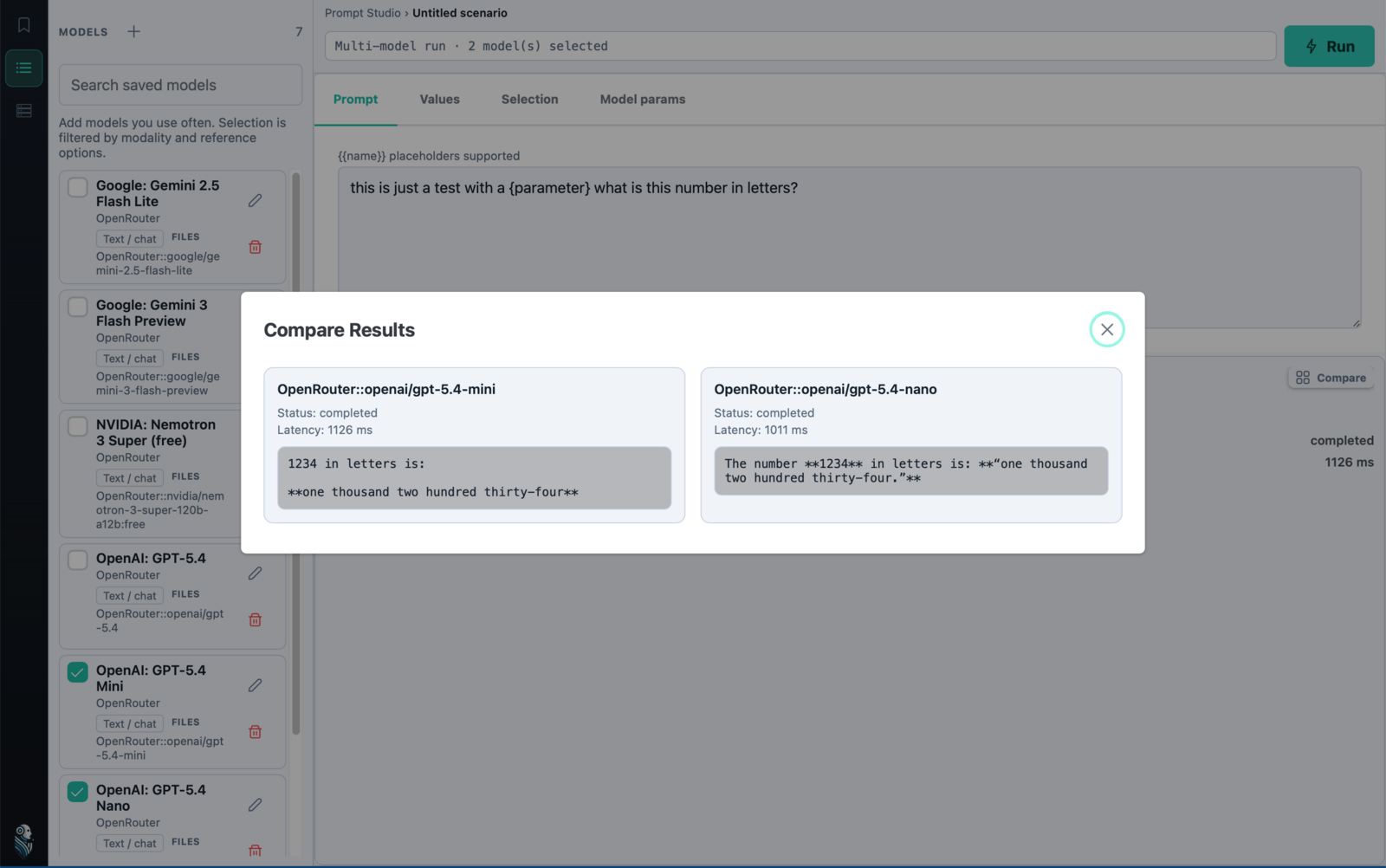
Test and compare prompts across every model, side by side, with your own API keys — right on your machine. Run one prompt against many models, compare output, latency, and cost, and ship the winner.
↓ Download the free desktop app See screenshots →
Why teams move prompts into VernaOne
| Prompts in your codebase | Prompts in VernaOne |
|---|---|
| Strings scattered across the repo, no history | Named, versioned endpoints with rollback |
| One SDK per provider, hard-coded model | One API; swap models by config |
| An outage or price hike means a code change | Automatic fallback across providers |
| No visibility into spend or quality | Cost analytics + evals per prompt version |
Author once. Run anywhere.
Turn your prompts into versioned, model-agnostic endpoints in minutes — free to start.
Launch VernaOne →Frequently asked
What is VernaOne?
VernaOne is a prompt registry and multi-provider router — the "Postman for AI." You author a prompt once as a versioned, named endpoint with {{variables}}, and call it from your code; VernaOne handles model and provider selection, automatic fallback, cost analytics, and evals. Change models without changing code.
How is VernaOne different from PromptLayer, Langfuse, or Helicone?
Those tools mostly observe and log your LLM calls. VernaOne makes the prompt itself portable and executable: a prompt becomes a model-agnostic endpoint that runs across providers with automatic fallback, side-by-side comparison, versioning, and token compression — not just logging after the fact.
Which LLM providers does VernaOne support?
OpenAI, Anthropic, Google, Mistral, xAI, Groq, and DeepSeek, plus OpenRouter — behind one prompt-centric API. You call a named prompt; VernaOne routes it to the configured model and falls back across providers on failure.
Is there a free version?
Yes — a free tier and a free desktop app (the "Postman for AI"), plus free tools like the Prompt Auditor, Portability Linter, and Cost Calculator.